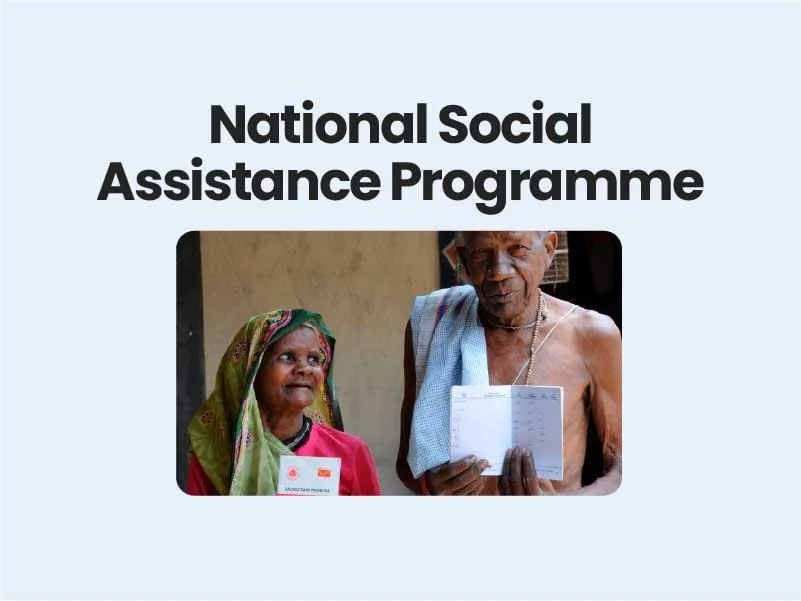
The National Social Assistance Programme (NSAP) is a flagship welfare initiative launched by the Government of India on August 15, 1995. It represents a significant step toward fulfilling the Directive Principles of State Policy enshrined in the Constitution, which urge the state to provide public assistance to its citizens in cases of old age, sickness, disablement, and other undeserved want.
Managed by the Ministry of Rural Development, the National Social Assistance Programme (NSAP) serves as a critical safety net for households living below the poverty line (BPL).
What is the National Social Assistance Programme (NSAP)?
The National Social Assistance Programme (NSAP) is a Centrally Sponsored Scheme that provides financial assistance to the elderly, widows, and persons with disabilities. Unlike many other welfare schemes that are contributory (where the worker pays in), the National Social Assistance Programme (NSAP) is a “non-contributory” social pension. This means the government provides 100% of the defined benefit to those who qualify based on their socio-economic status.
Initially, the program consisted of three schemes. Today, the National Social Assistance Programme (NSAP) has expanded to include five distinct components:
Key Benefits of the National Social Assistance Programme (NSAP):
The benefits under the National Social Assistance Programme (NSAP) are designed to provide monthly liquidity and emergency relief to the most vulnerable.
1. Monthly Pensions:
Old Age (IGNOAPS): Senior citizens (BPL) aged 60–79 receive ₹200/month, while those aged 80+ receive ₹500/month.
Widows (IGNWPS): BPL widows aged 40–79 receive ₹300/month. Upon reaching 80, the amount increases to ₹500/month.
Disability (IGNDPS): BPL individuals (18–79 years) with severe or multiple disabilities receive ₹300/month. This increases to ₹500/month at age 80.
2. Lump Sum Assistance (NFBS):
The National Social Assistance Programme (NSAP) provides a one-time grant of ₹20,000 to a BPL family if the primary breadwinner (aged 18–59) passes away. This helps the family recover from the immediate financial shock.
3. Food Security (Annapurna):
For senior citizens who are eligible for a pension but are not yet receiving one, the National Social Assistance Programme (NSAP) provides 10 kg of free food grains monthly to prevent hunger.
Note: Many State Governments add a “top-up” amount to these central contributions, often making the total pension significantly higher (e.g., ₹1,000 to ₹3,000 depending on the state).
How to Apply for the National Social Assistance Programme (NSAP):
The application process for the National Social Assistance Programme (NSAP) is decentralized to ensure that even those in remote villages can access it.
Step 1: Eligibility Verification
Ensure you have a BPL Certificate or are listed in the BPL Census database. This is the primary requirement for all sub-schemes of the National Social Assistance Programme (NSAP).
Step 2: Documentation
Prepare the following documents:
- Proof of Age: Birth certificate, Aadhar card, or school certificate.
- Income/BPL Proof: BPL Ration Card or Income Certificate.
- Disability Certificate: (For IGNDPS) Issued by a medical board.
- Death Certificate: (For NFBS) Of the primary breadwinner.
Bank Details: Passbook copy for Direct Benefit Transfer (DBT).
Step 3: Submission
- Rural Areas: Submit the application form to the Gram Panchayat or Block Development Office (BDO).
- Urban Areas: Submit to the Municipality or District Social Welfare Office.
- Online: Many states now accept applications via the official NSAP Portal (nsap.nic.in) or through Common Service Centres (CSCs).
Step 4: Verification and Approval
The Social Welfare Department verifies the details. Once approved, the pension is credited directly to the beneficiary’s bank account or post office account.
Conclusion:
The National Social Assistance Programme (NSAP) remains a cornerstone of India’s commitment to social justice. By providing a combination of monthly pensions, emergency grants, and food security, the National Social Assistance Programme (NSAP) ensures that poverty does not rob the elderly, widows, or the disabled of their right to live with dignity. While challenges like administrative delays and the need for higher pension amounts persist, the shift toward Direct Benefit Transfer (DBT) has made the program more transparent and efficient than ever before.
FAQs:
Q. Who is eligible for the National Social Assistance Programme (NSAP)?
A. Any individual belonging to a household Below the Poverty Line (BPL) who meets the specific age or health criteria (elderly, widow, or disabled) is eligible.
Q. Can I apply for two pensions under NSAP?
A. Generally, an individual can only draw one pension. For example, an elderly widow will typically be enrolled under either the Old Age or Widow pension scheme.
Q. How is the pension paid?
A. Benefits under the National Social Assistance Programme (NSAP) are paid via Direct Benefit Transfer (DBT) to the beneficiary’s bank account or post office account to prevent leakage.
Q. Is the NSAP available in all states?
A. Yes, the National Social Assistance Programme (NSAP) is a nationwide program implemented across all States and Union Territories in India.
Q. What is the role of the Gram Sabha in NSAP?
A. The Gram Sabha plays a crucial role in identifying eligible beneficiaries and conducting social audits to ensure the funds reach the right people.
| More Related Articles On Schemes and Policies… |
| Meghalaya Health Insurance Scheme (MHIS) | Contributory Pension Scheme (NPS) |
| Pradhan Mantri Awas Yojana Eligibility, Subsidy & All Details | Schemes And Policies For Tribal People! |
| Swadesh Darshan Scheme: Know In Details About The Scheme | Know All About The State Employee Cashless Treatment Scheme |
| Aam Aadmi Bima Yojana (AABY): Know In Details About It Here | Senior Citizen Tax Savings Scheme in India |
| Pradhan Mantri Rozgar Yojana Loan Online A/C Opening Process | Employment State Insurance Scheme (ESIS): Get A Brief Idea |
| Modi Scheme For Loan To Aid Financial Stability & Economic Development | Deen Dayal Swasthya Seva Yojana |
| Atal Pension Yojana Benefits | Know About The Scheme | 5 Government Insurance Schemes in India |
| Insurance scheme in India: To help people emergencies | PM insurance schemes: To help people in medical emergencies |
| Standup India Scheme Features, Eligibility & Related Details | 5 Best LIC Policy 2020 in India! |
| AB Arogyadaan Group Health Policy | Indian Post Office Monthly Income Scheme Or POMIS |
| Know About Some Important Government Schemes For Farmers | Environmental Policy And Associated Schemes Introduced For Wetlands! |
| Universal Health Insurance Scheme | Five Year Plan In India | Economic Planning |
| DOPT Orders On Medical Reimbursement | Get A Brief Idea About The LIC Jeevan Akshay VI Plan |
| Pradhan Mantri Jeevan Jyoti Bima Yojana or PMJJBY | Pradhan Mantri Kaushal Vikas Yojana Guidelines & Features |
| Interest Rate And Rule Of Senior Citizen Saving Scheme | Know In Details About Rashtriya Swasthya Bima Yojana (RSBY) |
| Janashree Bima Yojana (JBY) Subsidy, Benefits, Eligibility | Which Is the Best Investment Plan In India For Middle Class? |
| Pradhan Mantri Suraksha Bima Yojana SBI or PMSBY | See The Procedure To Mudra Bank Loan Apply Online |
| New Bima Kiran Policy | Bima Kiran Policy Features |
| Old Bima Kiran Lic Policy | Bima Kiran Policy Maturity |
| SBI Smart Champ Policy Details | Rajiv Arogya Bhagya (Rab) Scheme: Know In Details About It |
| How to Apply for Bal Jeevan Bima Yojana: A Step-by-Step Guide | Bal Jeevan Bima Yojana Premium and Coverage: All You Need to Know |
| Real Customer Reviews and Testimonials for Bal Jeevan Bima Yojana | List of Diseases Covered Under Rajiv Arogya Bhagya Scheme |
| The Benefits of Buying an LIC Policy Online vs. Through an Agent | Bal Jeevan Bima Yojana vs. Other Child Insurance Plans in India |
| How to Choose the Right LIC Policy for Your Family’s Needs | Documents Required for Rajiv Arogya Bhagya Scheme Application |
| Frequently Asked Questions About Rajiv Arogya Bhagya Scheme | 5 Common Mistakes to Avoid When Buying LIC Policy Online |
| Understanding the Tax Benefits of LIC Policies Purchased Online | Step-by-Step Guide to Compare LIC Policies Online |
| Impact of Rajiv Arogya Bhagya Scheme on Healthcare in Karnataka | Benefits of Rajiv Arogya Bhagya Scheme: How It Can Help You |
| Eligibility Criteria for Rajiv Arogya Bhagya Scheme | Hospitals Empaneled Under Rajiv Arogya Bhagya Scheme |
| How to Apply for Rajiv Arogya Bhagya Scheme: Step-by-Step Guide | Rajiv Arogya Bhagya Scheme vs Other Health Insurance Schemes |
| Honest Review of Bima Kiran Policy No 111 | Banglar Yuba Sathi Scheme 2026: Eligibility, Benefits, How To Apply Online, Monthly Allowance for Unemployed Youth |
| Krishak Bandhu Scheme 2026: Eligibility, Benefits & How To Apply Online West Bengal | Aikyashree Scholarship 2026: Eligibility, Online Application & Status Check Guide |
| Medhashree Scholarship 2026: Online Application, Eligibility, and Status Check Guide | Yuvasree Scheme 2026: Eligibility, Online Application, and Benefits Guide |
| National Family Benefit Scheme (NFBS): Eligibility, Benefits & How to Apply | National Social Assistance Programme (NSAP): Benefits & How to Apply |
| National Apprenticeship Promotion Scheme (NAPS): Benefits, Eligibility, Features & How to Apply | INSPIRE Scholarship 2026: Eligibility, Benefits, Features & How to Apply Online |
| Pre-Matric Scholarship Scheme 2026: Eligibility, Benefits, Documents & How to Apply | Post-Matric Scholarship Scheme 2026: Eligibility, Benefits, Documents & How to Apply |
| Janani Suraksha Yojana (JSY): Complete Guide to Benefits, Eligibility, and Application Process (2026) | Personal Assistance Allowance Tamil Nadu 2026: Eligibility, Benefits, ₹1000 Amount & Application Process |
| Maintenance Allowance to Intellectually Disabled Persons Tamil Nadu 2026: Eligibility, Benefits, Amount & Application Process | Destitute Differently Abled Pension Scheme (DDAPS) Tamil Nadu 2026: Eligibility, Benefits, Amount & Application Process |
| Differently Abled Pension Scheme (DAPS) Tamil Nadu 2026: Eligibility, Benefits, Application Process & Amount | Sandhya Suraksha Karnataka 2026: Eligibility, Pension Amount, Benefits & Complete Application Guide |
| YSR Pension Kanuka Andhra Pradesh 2026: Eligibility, Benefits, Amount & Complete Application Guide | Divyang Pension Scheme Uttar Pradesh 2026: Eligibility, Benefits, Amount & Complete Application Guide |
| Sanjay Gandhi Niradhar Anudan Yojana Maharashtra 2026: Eligibility, Benefits, Amount & Application Guide | Maharashtra Disability Pension Scheme 2026: Eligibility, Benefits, Amount & Complete Application Guide |
| Kerala Disability Pension Scheme 2026: Eligibility, Benefits, Application Process & Complete Guide | Disability Relief Allowance Delhi: Complete Guide to Benefits, Eligibility, Application Process & Financial Assistance |
| Disability Pension Scheme Delhi: Complete Guide to Monthly Pension, Eligibility, Application Process & Benefits | Manabik Pension Scheme: Complete Guide to Benefits, Eligibility, Application & Impact in India |
| Niramaya Health Insurance Scheme: Complete Guide to Benefits, Eligibility, Coverage & Application Process in India | Indira Gandhi National Disability Pension Scheme (IGNDPS): Complete Guide to Benefits, Eligibility, Application Process & Impact in India |
| Assistance to Disabled Persons (ADIP Scheme): Complete Guide to Benefits, Eligibility, Application Process & Impact in India | Persons with Disabilities Scheme in Colleges: Complete Guide to Benefits, Eligibility, and Implementation |
| National Overseas Scholarship for Students with Disabilities: A Complete Guide to Eligibility, Benefits, and Application Process | Rashtriya Swasthya Bima Yojana (RSBY): Complete Guide to Benefits, Eligibility, and Application Process in India |
| Mahila Shakti Kendra Scheme (MSK): Complete Guide to Benefits, Eligibility, and Application Process in India | |