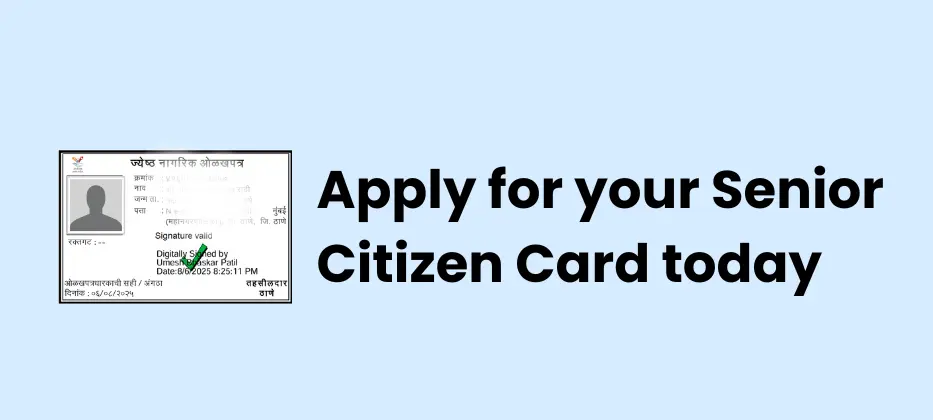

The Senior Citizen Card is an official identity card issued by various state governments in India to citizens who are 60 years of age and above. This card provides senior citizens with proof of age and eligibility to avail of several government welfare schemes, healthcare benefits, travel concessions, tax exemptions, and other privileges specially designed for elderly citizens.
This detailed article will help you understand everything about the Senior Citizen Card its purpose, benefits, eligibility criteria, application process (online and offline), and required documents.
What is a Senior Citizen Card?
Table of Contents
The Senior Citizen Card serves as a valid ID proof that confirms the holder is a senior citizen (typically aged 60 years and above). The card allows them to access a wide range of benefits offered by both central and state governments, public institutions, and private organizations. It is particularly helpful for accessing healthcare services, concessions in travel, and government welfare schemes meant exclusively for the elderly.
Eligibility Criteria for Senior Citizen Card in India:
A Senior Citizen Card is an important identification document that enables older adults in India to access a range of state and central government benefits, including healthcare concessions, travel discounts, priority services, and welfare schemes. While the exact eligibility requirements can vary from state to state, most regions follow a set of common criteria centered around age, residency, income, and special needs.
Age Requirement:
The primary criterion for obtaining a Senior Citizen Card is age. In most Indian states, individuals who are 60 years or older are eligible to apply. Some central schemes linked to senior citizens, such as specific health benefits under Ayushman Bharat, apply to those aged 70 years and above, but for the standard identity card, the age threshold is typically 60.
Residency Status:
Applicants must be permanent residents of the state in which they are applying for the card. Proof of address, such as an Aadhaar card, voter ID, or domicile certificate, is typically required. Certain states may specify a minimum number of years of residence, such as 10–15 years.
Income Criteria:
For the basic Senior Citizen Card, income is generally not a limiting factor. Any individual meeting the age and residency requirements can obtain it. However, income ceilings may apply when applying for linked welfare schemes, especially pension programs or financial assistance packages designed for economically weaker senior citizens.
Disability or Medical Conditions:
While disability is not mandatory for the card, seniors with age-related disabilities or chronic illnesses may be given priority or receive additional benefits. Some state-run social welfare schemes also require medical certificates to qualify for enhanced support.
Benefits of the Senior Citizen Card in India
The Senior Citizen Card in India is a significant initiative by the government to recognize and empower elderly citizens (typically 60 years and above) by providing them with access to various welfare programs, tax exemptions, healthcare benefits, and discounts. The card serves as an official identity proof for senior citizens and entitles them to numerous privileges designed to ease their living conditions, ensuring a dignified and comfortable life in their later years.
Priority in Medical Services:
Many state-run hospitals offer priority access to senior citizens, ensuring they receive quicker treatment, especially in crowded hospitals or emergencies.
Senior Citizen Health Insurance:
Some insurance companies offer dedicated health insurance plans that provide discounts or enhanced coverage for senior citizens. The Senior Citizen Card can be used to avail of these benefits or prove eligibility for senior-friendly policies.
Discounts on Medicines:
Certain government-approved pharmacies offer discounts on prescribed medicines for senior citizens holding the card. This can help reduce the financial burden of long-term medication.
Annual Health Check-ups:
Some states offer free or discounted health check-ups for senior citizens, particularly those registered under state or national health schemes. These check-ups include basic health screening tests, blood pressure monitoring, and diabetes tests, which are essential for early diagnosis and preventive care.
Travel Benefits:
Traveling becomes increasingly difficult for senior citizens due to health concerns, mobility issues, and financial constraints. To make travel easier and more affordable for them, the government provides benefits.
Financial Benefits:
Senior citizens face the challenge of managing finances post-retirement. The Senior Citizen Card provides several financial benefits to ensure economic security and assistance.
- Higher Interest Rates on Fixed Deposits (FDs)
- Income Tax Benefits
- Priority in Bank Services
Priority in Government Offices:
Senior citizens holding this card may be given priority service at government offices, reducing the waiting time for pension claims, social security applications, or other welfare schemes.
Reduced Entry Fees for Sports Events:
Senior citizens are often given discounts on tickets for cultural and sporting events, such as theater performances, music concerts, or sports matches.
Documents Required for Senior Citizen Card
While requirements may vary slightly by state, the following documents are commonly needed:
Proof of Age (Any one):
- Aadhaar Card
- PAN Card
- Voter ID with Date of Birth
- Birth Certificate
- Passport
- 10th Standard School Certificate (if it has DOB)
Proof of Residence (Any one):
- Aadhaar Card
- Utility Bill (Electricity/Water)
- Ration Card
- Voter ID
- Rent agreement (with affidavit if needed)
Passport-size Photographs: Usually 2–4 recent color photographs.
Identity Proof (if not used as proof of age/residence)
Who Issues the Senior Citizen Card?
The Senior Citizen Card in India is issued primarily by state government authorities, as there is no single nationwide issuing body. Each state has its own designated department responsible for processing applications, verifying documents, and providing the card to eligible senior citizens.
In most states, the card is issued through the Department of Social Welfare, Department of Revenue, or the Department of Social Justice and Empowerment. These departments operate through district-level offices such as the District Social Welfare Office, Tehsil Office, or local Citizen Service Centres like Seva Kendras, e-District portals, and Common Service Centres (CSCs).
For example, states like Maharashtra, Tamil Nadu, and Karnataka issue the Senior Citizen Certificate or Card through their Social Justice or Social Welfare Departments. Applicants typically submit required documents such as age proof, identity proof, and address proof through online portals or at district offices. Some states also mandate domicile certificates to ensure the applicant is a permanent resident.
In addition to state-issued cards, specific central government schemes, such as Ayushman Bharat for senior citizens issue special beneficiary cards through agencies like the National Health Authority (NHA).
Overall, Senior Citizen Cards are administered by state government welfare departments, ensuring locally managed access to benefits and support services for the elderly.
How to Apply for a Senior Citizen Card:
Depending on the state, the application process can be done online, offline, or through both modes.
Offline Application Process:
Visit the Local Government Office
Approach the District Social Welfare Office, Municipal Corporation, or Senior Citizen Cell in your area.
Collect the Application Form
Forms are usually available free of charge. You may also download them from your state’s official portal and fill them before visiting.
Fill the Form and Attach Documents
Fill in the required details carefully and attach self-attested copies of all documents.
Submit the Application
Submit it to the concerned official. You may receive an acknowledgment or reference number.
Verification and Card Issuance
After verification, the card is issued either instantly (in some cases) or within 2–3 weeks.
Online Application Process (where available):
Many states and union territories have introduced online portals for Senior Citizen Card applications.
How to Apply for a Senior Citizen Card Online:
Visit the Relevant Portal:
Start by going to your state’s e-District/citizen services portal (or via the National Services Portal). Alternatively, the state’s own portal.
Register/Log In:
If you are a new user, sign up with your mobile number, email, and Aadhaar. For registered users, simply log in using your credentials.
Select the Senior Citizen Service:
Navigate to the relevant category (such as Certificates, Welfare Services, or Senior Citizen Services) and choose “Senior Citizen Certificate / ID Card.”
In Maharashtra, the Aaple Sarkar portal has a “Senior Citizen Certificate” service under the Revenue / Social Welfare department.
On the ServicePlus portal, you can select “Application for Issuance of Senior Citizen ID Card” and pick the district / office for processing.
Fill the Application Form:
Enter your personal details: name, date of birth, gender, visible identification mark, major ailments (if any), blood group, etc. Provide address details as required.
Upload Documents:
Scan and upload supporting documents:
- Proof of age (Aadhaar, birth certificate, school leaving certificate)
- Proof of identity (Aadhaar, Voter ID, Passport, etc.)
- Proof of address (utility bill, ration card, passport, etc.)
- Passport-sized photograph (scanned clearly).
Pay the Fee (If Applicable):
Depending on your state’s portal, there may be a nominal application fee. For many states, applying via the e-District or state welfare portal is either free or involves a small service charge.
Use available payment methods (net banking, UPI, etc.) on the portal.
Submit and Note the Application Reference Number (ARN):
After submitting, you will receive a reference number / ARN. Save or note it down — you’ll need this to track the status of your application.
Verification by Local Authority:
The application is forwarded to a local office (Tehsildar / SDM / social welfare office) for verification.
There may be physical verification or background checks via the local administrative office.
Download Certificate/Card:
Once approved, log back into the portal → go to “Track Application / Download Certificate” → enter your ARN.
You should be able to download a PDF certificate immediately.
In some states (like Maharashtra and Delhi), a physical laminated senior citizen card may also be dispatched.
Processing Time, Fees, and Validity of Senior Citizen Card:
The processing time, fees, and validity of a Senior Citizen Card vary by state but generally follow a simple and citizen-friendly structure. Most applications are processed quickly at minimal or no cost, and the cards typically carry lifetime validity, ensuring long-term access to senior-specific benefits and services.
Processing Time:
The processing time for a Senior Citizen Card varies by state and the mode of application (online/offline), but most state portals follow a similar timeline:
- Average processing time: 7 to 15 working days
- Fast-track states: Some states, especially those using e-District and ServicePlus systems, process applications within 3–7 days.
- Document verification delay: If additional verification is required (such as domicile or age proof inconsistencies), the process may extend to 20–30 days.
- Physical card dispatch: States that issuing a laminated physical card may take 1–2 weeks extra for delivery after approval.
Fees:
Senior Citizen Cards are intended to be accessible to all, so the fees are minimal or zero in most states.
- Online application fee: Usually Free or ₹10 to ₹50, depending on the state portal.
- Service centre fee: When applying through Common Service Centres (CSCs) or e-Seva centres, a service charge of ₹20–₹60 may apply.
- No hidden charges: There are typically no renewal charges, unless a re-issue is requested for name correction, photo update, or loss of card.
Validity:
The validity of the Senior Citizen Card depends on the issuing authority, but most follow standard rules:
- Lifetime validity is the norm in a majority of Indian states.
- Cards issued as PDF certificates from e-District portals generally have permanent validity unless the format is updated by the government.
- Some states may issue cards that require renewal after 5–10 years, especially if they contain photographs or physical laminated cards subject to wear.
- Re-issue may be required if there is a change in address, name, or Aadhaar update.
Renewal Process & Validity Period:
Validity Period:
The validity of a Senior Citizen Card depends on the issuing state, but most follow these common rules:
Lifetime Validity:
In many states, the Senior Citizen Card is issued with permanent or lifetime validity, as the age criteria (60+) does not change.
Fixed Validity (5–10 Years) in Some States:
States that issue laminated physical cards or photo-based ID cards may set a validity of 5 to 10 years to ensure updated photographs and identity information.
Re-Issue Required When:
- Change of address or name
- Aadhaar details updated
- The card is lost, damaged, or illegible
Renewal Process:
Even though many cards are permanent, renewal or re-issue may be required in certain situations. The general renewal process is:
Visit the State Portal / e-District Portal
Select the service for Renewal / Re-issue of Senior Citizen Card.
Log in and Choose “Renewal” or “Duplicate Card”
Options typically include updating personal details or requesting a fresh card.
Upload Updated Documents
- Recent photograph
- Updated Aadhaar or new address proof (if applicable)
- Old Senior Citizen Card (scanned copy)
Pay the Nominal Fee
Renewal/re-issue fees usually range from ₹10 to ₹50, depending on the state.
Submit and Track Application
A new digital certificate or physical card is issued after verification, often within 3–10 working days.
State-Wise Application Links, Forms & Portals:
| State / UT | Portal Name | Application Link / Forms |
|---|---|---|
| Andhra Pradesh | AP Seva / MeeSeva | https://ap.meeseva.gov.in |
| Arunachal Pradesh | State e-Services | https://eservice.arunachal.gov.in |
| Assam | e-District Assam | https://edistrict.assam.gov.in |
| Bihar | RTPS Bihar | https://serviceonline.bihar.gov.in |
| Chhattisgarh | e-District Chhattisgarh | https://edistrict.cgstate.gov.in |
| Goa | Goa Online Services | https://goaonline.gov.in |
| Gujarat | Digital Gujarat | https://www.digitalgujarat.gov.in |
| Haryana | SARAL Haryana | https://saralharyana.gov.in |
| Himachal Pradesh | e-District HP | https://edistrict.hp.gov.in |
| Jharkhand | JharSewa | https://jharsewa.jharkhand.gov.in |
| Karnataka | Nadakacheri | https://nadakacheri.karnataka.gov.in |
| Kerala | Akshaya / e-District | https://edistrict.kerala.gov.in |
| Madhya Pradesh | MP e-District | https://services.mp.gov.in |
| Maharashtra | Aaple Sarkar | https://aaplesarkar.maharashtra.gov.in |
| Manipur | Manipur e-District | https://edistrict.manipur.gov.in |
| Meghalaya | Meghalaya e-District | https://www.megegov.gov.in |
| Mizoram | Mizoram e-District | https://edistrict.mizoram.gov.in |
| Nagaland | Nagaland e-District | https://edistrict.nagaland.gov.in |
| Odisha | Odisha One | https://www.odishaone.gov.in |
| Punjab | Punjab e-District / Connect Punjab | https://connect.punjab.gov.in |
| Rajasthan | Jan Soochna / e-Mitra | https://emitra.rajasthan.gov.in |
| Sikkim | Sikkim e-District | https://edistrict.sikkim.gov.in |
| Tamil Nadu | TNeGA / e-Sevai | https://www.tnesevai.tn.gov.in |
| Telangana | TS MeeSeva | https://ts.meeseva.telangana.gov.in |
| Tripura | Tripura e-District | https://edistrict.tripura.gov.in |
| Uttar Pradesh | e-District UP | https://edistrict.up.gov.in |
| Uttarakhand | UK e-District | https://eservices.uk.gov.in |
| West Bengal | WB e-District | https://edistrict.wb.gov.in |
| Delhi (NCT) | Delhi e-District | https://edistrict.delhigovt.nic.in |
| Jammu & Kashmir | J&K e-Services | https://jk.gov.in/jkeservices |
| Ladakh | Ladakh e-Gov Services | https://ladakh.nic.in |
| Puducherry | Puducherry e-District | https://edistrict.py.gov.in |
| Andaman & Nicobar Islands | e-District A&N | https://andaman.nic.in |
| Chandigarh | Chandigarh e-Sampark | https://sampark.chd.gov.in |
| Dadra & Nagar Haveli & Daman & Diu | DNHDD e-District | https://www.dnh.gov.in |
| Lakshadweep | Lakshadweep e-District | https://lakshadweep.gov.in |
Conclusion:
The Senior Citizen Card is more than just an ID — it’s a gateway to numerous benefits and services aimed at enhancing the quality of life for elderly citizens in India. From healthcare and financial security to travel and legal support, the card ensures that senior citizens are treated with the dignity and care they deserve.
If you or someone in your family is eligible, applying for a Senior Citizen Card is a step toward a more secure and supported future. Always check your state’s official portal or local welfare office for the most accurate and updated process.
FAQ:
Q. Is the Senior Citizen Card mandatory to get benefits?
A. No, it’s not always mandatory. However, having a Senior Citizen Card simplifies the process of availing many benefits, especially government schemes and travel concessions.
Q. Is there any fee for applying for the card?
A. In most states, the application process is free of cost. However, some states may charge a nominal fee (e.g., ₹25–₹50).
Q. Can NRI senior citizens apply for the card?
A. Generally, only resident Indian citizens are eligible. NRIs may not be eligible unless they reside in India for a significant duration and fulfill residency criteria.
Q. What is the minimum age for applying?
A. The minimum age is usually 60 years, although some benefits (like “Super Senior Citizen” privileges) begin at 80 years.
Q. What should I do if my card is lost or damaged?
A. You should report the loss to the issuing authority and apply for a duplicate card with your original documents.
Q. What is the age requirement?
A. The minimum age requirement for obtaining a Senior Citizen Card in India is generally 60 years or older.
Q. Can NRIs apply?
A. No, NRIs (Non‑Resident Indians) are generally not eligible for a Senior Citizen Card in India most state-level schemes require residency.
Q. Is there an application fee?
A. No fee for online application; ₹ 50 for offline application.
Q. Is senior citizen card same as Aadhar?
A. No, a Senior Citizen Card is not the same as Aadhaar. They serve different purposes and are issued by different authorities.