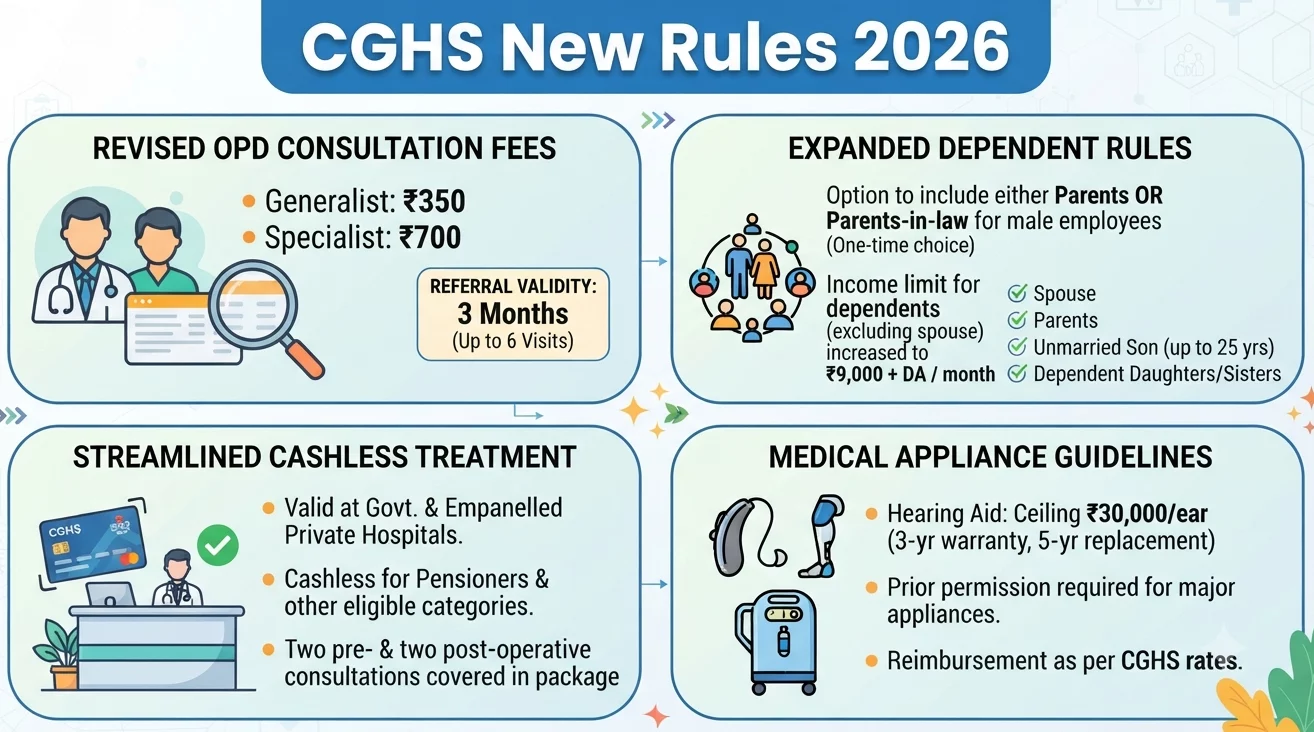
The CGHS new rules 2026 bring important changes for central government employees, pensioners, and their families. The Central Government Health Scheme (CGHS) covers approximately 42.6 lakh beneficiaries across 80 cities. Recent updates include revised hospital rates, digital services, PAN linking, and changes to medical reimbursement procedures.
This page explains the important CGHS changes, their effective dates, and what beneficiaries need to know. For information about what CGHS is and who is eligible, read our complete CGHS explainer. You can also visit the CGHS official website for official notifications and beneficiary services.
CGHS Changes at a Glance (2025–2026)
Here is a quick overview of the major CGHS updates announced during 2025 and 2026.
| Date | What changed | Who it helps |
|---|---|---|
| 28 April 2025 | New CGHS website, PAN linking, and online payment changes | All beneficiaries |
| 13 October 2025 | Revised hospital treatment rates for around 2,000 procedures | Employees, pensioners, and families |
| August 2026 | Clarification of consultation, diagnostic test, and referral procedures | Patients using CGHS hospitals |
| 2026 | myCGHS digital services and app facilities | All beneficiaries |
These changes affect hospital billing, digital services, and the way beneficiaries access healthcare facilities. The following sections explain each update.
New CGHS Hospital Rates (From 13 October 2025)
The government revised CGHS hospital rates through Office Memorandum (OM) F.No. 5-16/CGHS(HQ)/HEC/2024 (Part I), dated 3 October 2025. The revised rates became effective on 13 October 2025.
This was the first major revision since 2014. Around 2,000 medical procedures were included in the revised rate structure.
Under the new system, treatment rates depend on four important factors:
- Hospital accreditation.
- Type of hospital.
- City category.
- Type of hospital ward.
The purpose is to provide a more structured payment system for hospitals and make treatment costs easier to calculate.
How Are the New CGHS Rates Calculated?
The CGHS new rates are calculated using the applicable base package rate and adjustments for hospital category, city and ward.
The following table explains the official adjustments.
| Category | Rate adjustment |
|---|---|
| NABH/NABL hospital | Base rate |
| Non-NABH/Non-NABL hospital | 15% lower |
| Super speciality hospital | 15% higher |
| Tier-II (Y) city | 10% lower |
| Tier-III (Z) city | 20% lower |
| General ward | 5% lower |
| Semi-private ward | Base rate |
| Private ward | 5% higher |
Example: Understanding the New CGHS Rates
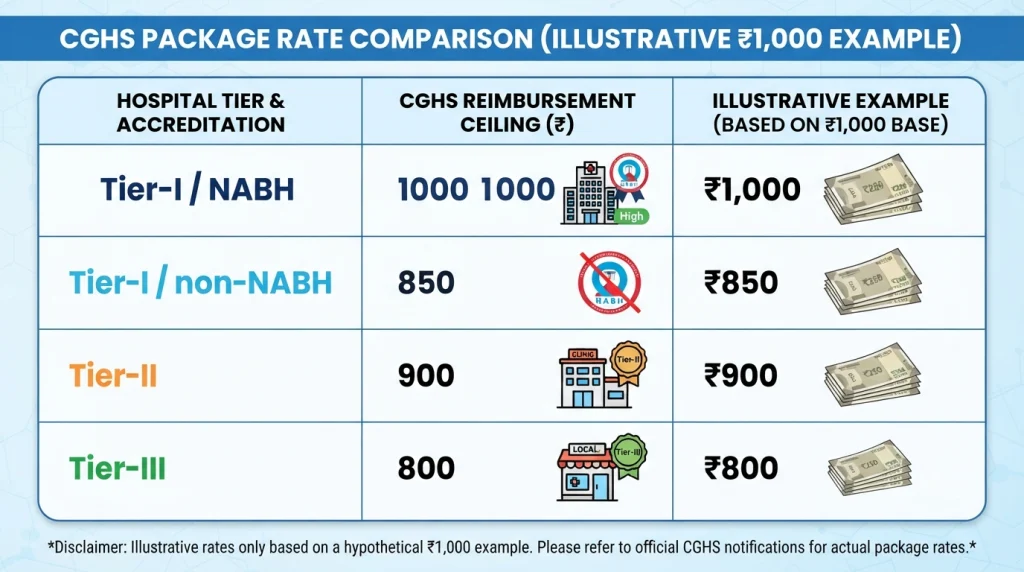
Suppose the base package rate for a procedure at an NABH-accredited hospital in a Tier-I city is ₹1,000.
The applicable rates would be:
| Hospital and city category | Applicable rate |
|---|---|
| NABH, Tier-I city | ₹1,000 |
| Non-NABH, Tier-I city | ₹850 |
| NABH, Tier-II city | ₹900 |
| NABH, Tier-III city | ₹800 |
The CGHS wellness centres in your city make it easier to understand how accreditation and city categories affect treatment costs.
For example, beneficiaries looking for the CGHS Kolkata hospital list should check the current empanelled hospital directory and the applicable hospital category before planning treatment.
What Did Not Change Under the New Rate Structure?
Not every medical service received a revised rate.
Some important provisions remain unchanged.
| Medical service | Applicable rule |
|---|---|
| OPD consultation | ₹350 |
| IPD consultation | ₹350 |
| Radiotherapy | Same across wards |
| Investigations | Same across wards |
| Day-care procedures | Same across wards |
| Minor procedures without admission | Same across wards |
Cancer surgery rates also continue under the existing CGHS rules. The revised rates apply to chemotherapy, investigations, and radiotherapy.
What Do the Revised Rates Mean for Beneficiaries?
Empanelled hospitals were required to accept the revised rates by 13 October 2025. Hospitals that did not accept the new rates were subject to removal from the CGHS panel.
The revised rates also apply when eligible beneficiaries claim medical reimbursement.
Treatment at a non-empanelled private hospital is reimbursed only at the applicable non-NABH rate for that city, and only in exceptional cases under the prescribed rules.
CGHS 5 km Rule Removed for Serving Employees (17 September 2026)
The government has made an important change to CGHS eligibility by removing the geographical restriction for serving central government employees.
Earlier, employees generally needed to live or be posted within approximately 5 km of a CGHS Wellness Centre to become eligible for CGHS facilities.
However, the Office Memorandum (OM) No. Z.16025/227/2026/CGHS-III/EHS, dated 17 September 2026, removed this distance-based condition with immediate effect.
This means serving central government employees are no longer restricted by the earlier 5 km distance requirement.
Old CGHS Rule vs New CGHS Rule
| Particulars | Earlier rule | New rule |
|---|---|---|
| Distance requirement | Approximately 5 km from a CGHS Wellness Centre | No 5 km distance restriction |
| Employees outside CGHS areas | Generally covered under CS(MA) Rules | Can opt for CGHS once |
| Eligibility | Linked to geographical conditions | Distance condition removed |
| Choice of scheme | Subject to existing eligibility rules | One-time option to choose CGHS |
This change is particularly useful for employees posted in areas where CGHS facilities are not located nearby.
Employees can now consider joining CGHS even if they live outside the earlier geographical coverage area.
How to Choose CGHS Under the One-Time Option?
The government has provided a one-time option for eligible serving employees who are currently covered under CS(MA) Rules.
The process involves the following steps:
- Download and fill in the prescribed Option and Undertaking Form.
- Submit the completed form to your Head of Office or Drawing and Disbursing Officer (DDO).
- Once the option is accepted, the applicable monthly CGHS contribution will start.
- The employee and eligible family members will come under CGHS as per the applicable rules.
There are some important conditions to remember:
- The choice is final and binding.
- The option applies to the entire eligible family.
- Employees cannot claim medical benefits under both CGHS and CS(MA) Rules.
- Monthly CGHS contributions become applicable after opting for the scheme.
- No Travel Allowance or Dearness Allowance (TA/DA) is payable for travelling to obtain CGHS treatment.
Employees should carefully consider the available medical facilities and contribution requirements before submitting the one-time option.
Important: The reported order also specifies a CGHS requirement for employees living or posted at district headquarters where a CGHS Wellness Centre is available. Check the original OM for the applicable conditions.
Lifetime CGHS Cover for Some Dependent Sons and Brothers (1 September 2026)
Another important CGHS update concerns the continuation of medical benefits for certain dependent family members.
Earlier, the general age limits for dependent family members included:
- A dependent son could receive CGHS benefits up to 25 years of age.
- A dependent brother could receive benefits up to 18 years of age.
- There was no age limit in cases of permanent disability, subject to the applicable conditions.
The government has reportedly relaxed these provisions for certain dependent sons and brothers suffering from serious medical conditions.
Under the Office Memorandum dated 1 September 2026, a dependent son or brother suffering from a chronic, critical or terminal illness may be considered for lifetime CGHS coverage.
However, this is not an automatic extension for every dependent family member. Each application is examined individually.
What Are the Conditions for Lifetime Coverage?
The reported revised provisions include the following conditions:
| Particulars | New provision |
|---|---|
| Eligible family members | Dependent sons and brothers |
| Medical condition | Chronic, critical or terminal illness |
| Age restriction | Lifetime continuation may be allowed |
| Approval process | Medical Board assessment |
| Decision | Case-by-case basis |
| Marriage | Marriage alone does not end eligibility if dependency continues |
A Medical Board assessment is required to establish the medical condition and eligibility of the dependent family member.
The decision is reportedly taken at the Additional Director level, with an appeal facility available through CGHS Headquarters.
The relaxation also applies to eligible beneficiaries under the Central Services (Medical Attendance) Rules, 1944.
Does Marriage Automatically End CGHS Eligibility?
No. Under the reported revised provision, marriage alone does not automatically end eligibility if the prescribed dependency conditions continue to be satisfied.
However, the applicant must still meet the applicable medical and financial dependency requirements.
This change can provide important relief to families caring for dependent sons or brothers with serious long-term illnesses.
Beneficiaries should submit the necessary medical documents and dependency details and obtain confirmation from their CGHS authorities before assuming that lifetime coverage has been approved.
Faster Medical Reimbursement Approvals (25 June 2026)
The government has also reportedly increased the financial powers of officers responsible for approving CGHS medical reimbursement claims.
The Office Memorandum dated 25 June 2026 revised the financial limits for different approving authorities.
Under the revised arrangement, officers can approve higher-value claims than before.
Revised CGHS Medical Reimbursement Approval Limits
| Approving authority | Earlier limit | Revised limit |
|---|---|---|
| Additional Director | ₹7 lakh | ₹15 lakh |
| Director | ₹15 lakh | ₹25 lakh |
| Additional Secretary and Director General (AS&DG) | ₹25 lakh | ₹50 lakh |
Claims exceeding ₹50 lakh require approval from the Ministry.
The revised limits also cover changes to approval powers for certain unlisted medical items.
Revised Limits for Unlisted Medical Items
| Approving authority | Earlier limit | Revised limit |
|---|---|---|
| Additional Director | ₹1 lakh | ₹2 lakh |
| Director | ₹3 lakh | ₹5 lakh |
| Additional Secretary and Director General | ₹5 lakh | ₹10 lakh |
What Does This Mean for CGHS Beneficiaries?
The increase in financial approval powers means that higher-value medical reimbursement claims can be approved at lower administrative levels.
This can reduce the need to forward every large claim to a higher authority and may help beneficiaries receive decisions more quickly.
However, reimbursement remains subject to applicable CGHS rules, supporting medical documents, and approval procedures.
Pensioners and serving employees should ensure that their reimbursement applications include the required bills, prescriptions, medical reports, and other supporting documents.
Test and Referral Rules: Important Clarifications in August 2026
CGHS beneficiaries should also understand the clarified rules for specialist consultations, diagnostic tests and referrals.
These clarifications relate to existing instructions under the CGHS Office Memoranda dated 28 June 2024 and 3 October 2025, and the Standard Operating Procedure dated 2 September 2024.
The important provisions are:
| Situation | Applicable rule |
|---|---|
| Follow-up consultation | Valid for 7 days in the same specialty |
| Test costing up to ₹3,000 | Can be performed at the same empanelled hospital when prescribed by its specialist |
| Test at another hospital | Wellness Centre referral required |
| CT scan, MRI, or PET scan | Wellness Centre referral required |
| Test costing above ₹3,000 | Wellness Centre referral required |
What Should Beneficiaries Remember?
A specialist consultation remains valid for seven days for follow-up treatment in the same specialty.
If an empanelled hospital specialist recommends a diagnostic test costing up to ₹3,000, the beneficiary should get it done at that same hospital.
However, if the patient wants to undergo the test at another hospital or needs a CT, MRI, or PET scan, a referral from the CGHS Wellness Centre is required.
The same referral requirement applies to tests costing more than ₹3,000.
Following these instructions can help beneficiaries avoid unnecessary delays and problems with reimbursement.
New CGHS Website, PAN Linking and Online Payment (From 28 April 2025)
Another important CGHS update concerns its online services and beneficiary identification system.
From 28 April 2025, beneficiaries were directed to use the new CGHS website: https://cghs.mohfw.gov.in/
The older websites, cghs.gov.in and cghs.nic.in, were discontinued.
The new portal provides access to CGHS information and online beneficiary services.
PAN Linking With CGHS Beneficiary ID
Beneficiaries aged above 18 years must link their PAN with their CGHS Beneficiary ID.
This requirement helps connect beneficiary records with the updated digital system.
Beneficiaries should check their details and complete the linking process through the official portal.
Online CGHS Contribution Payment
Another change concerns the payment of CGHS contributions.
Contributions must be paid through the CGHS website. The earlier Bharatkosh payment facility was discontinued for this purpose.
How to Apply for a CGHS Card?
Beneficiaries who need to apply for a new CGHS card or access card-related services should use the official CGHS portal and follow the applicable application procedure.
They should ensure that their personal information and family details are correctly entered.
For existing beneficiaries, checking the PAN and Beneficiary ID details is also important.
myCGHS App: What Can Beneficiaries Do?
The myCGHS app makes several CGHS services available through a smartphone.
It is designed to reduce the need for beneficiaries to visit offices for routine digital services.
The app is available for Android and iOS users.
Important Features of the myCGHS App
Beneficiaries can use the app for several purposes:
- Book and cancel medical appointments.
- Download their CGHS card.
- View laboratory reports.
- Check medicine history.
- Track medical reimbursement claims.
- Transfer their CGHS card.
- Add eligible dependants.
- Change their CGHS card type.
How to Book a CGHS Appointment Online?
Beneficiaries can use the myCGHS app to book an appointment.
The general process is:
- Download the myCGHS app on your smartphone.
- Log in using the required beneficiary details.
- Select the appointment booking service.
- Follow the instructions to choose the available appointment.
- Check the appointment details after booking.
The app also allows beneficiaries to cancel appointments when necessary.
It is useful for pensioners and family members who want easier access to their CGHS information without repeatedly visiting a Wellness Centre.
CGHS Contribution Rates 2026
The CGHS contribution rates applicable to central government employees are based on their pay level under the 7th Pay Commission.
These monthly subscription rates have remained unchanged since 1 January 2017.
The current contribution structure is given below.
| Pay level | Monthly contribution |
|---|---|
| Level 1–5 | ₹250 |
| Level 6 | ₹450 |
| Level 7–11 | ₹650 |
| Level 12 and above | ₹1,000 |
CGHS Contribution for Pensioners
Pensioners can pay their CGHS subscription monthly or opt for a lifetime card with a one-time payment equivalent to 120 months of contributions.
The applicable amounts are:
| Pay level | Lifetime contribution |
|---|---|
| Level 1–5 | ₹30,000 |
| Level 6 | ₹54,000 |
| Level 7–11 | ₹78,000 |
| Level 12 and above | ₹1,20,000 |
This option allows eligible pensioners to make a one-time contribution instead of paying the subscription every month.
Beneficiaries should check their applicable pay level and card entitlement before making the payment.
Note: Freedom fighters and other specially covered beneficiary categories should check the applicable government provisions for their entitlement and reimbursement conditions.
Will the 8th Pay Commission Change CGHS Contribution Rates?
The CGHS contribution structure is linked to the Pay Commission.
However, the implementation of the 8th Pay Commission does not automatically change the existing CGHS subscription amounts.
Any revision to CGHS contribution rates will require a separate official government order.
Therefore, employees and pensioners should continue to follow the existing contribution schedule until a new notification is issued.
FAQs
Q. What are the new CGHS rates from October 2025?
A. The government revised CGHS rates for around 2,000 procedures from 13 October 2025. Under the new structure, rates depend on hospital accreditation, hospital type, city category, and ward. Non-NABH hospitals receive 15% lower rates, super speciality hospitals receive 15% higher rates, Tier-II cities have a 10% reduction, and Tier-III cities have a 20% reduction compared with Tier-I cities.
Q. Has the CGHS 5 km rule been removed?
A. The Ministry of Health and Family Welfare reportedly issued an Office Memorandum dated 17 September 2026 concerning the removal of the geographical restriction for serving central government employees. The original order and its conditions should be checked on the official CGHS portal before relying on the change.
Q. Can I switch back to CS(MA) after choosing CGHS?
A. The reported 17 September 2026 order describes the one-time option as final and binding. It also states that the choice applies to the eligible family members. Beneficiaries should verify the original OM before exercising this option.
Q. Can a dependent son get CGHS after 25 years?
A. An Office Memorandum dated 1 September 2026 reportedly provides for lifetime medical coverage for certain dependent sons and brothers suffering from critical or terminal illnesses. The extension is subject to dependency conditions and Medical Board assessment. The provision must be checked against the original government order.
Q. Is PAN linking mandatory for CGHS?
A. Yes. Beneficiaries above 18 years must link their PAN with their CGHS Beneficiary ID under the updated digital system. They should use the official CGHS website to check and complete the required process.
Q. What can I do on the myCGHS app?
A. The myCGHS app allows beneficiaries to book and cancel appointments, download CGHS cards, view laboratory reports, check medicine history and track reimbursement claims. It also provides facilities for card transfer, adding dependants, and changing card type.
Q. What is the CGHS contribution in 2026?
A. The monthly CGHS contribution is ₹250 for Pay Levels 1–5, ₹450 for Level 6, ₹650 for Levels 7–11 and ₹1,000 for Level 12 and above. These contribution rates have remained unchanged since 2017.
Q. Is the CGHS consultation fee the same in all cities?
A. Yes. The OPD and IPD consultation fee is ₹350. It remains the same across cities and wards under the revised CGHS rate structure.
Sources and Official CGHS Links:
Beneficiaries should always check the original government notifications before making decisions about their healthcare entitlements.
The following sources provide information about the changes discussed in this article.
- CGHS Official Website
- CGHS Revised Hospital Rates Order (3 October 2025)
- Business Standard – Revised CGHS Hospital Rates