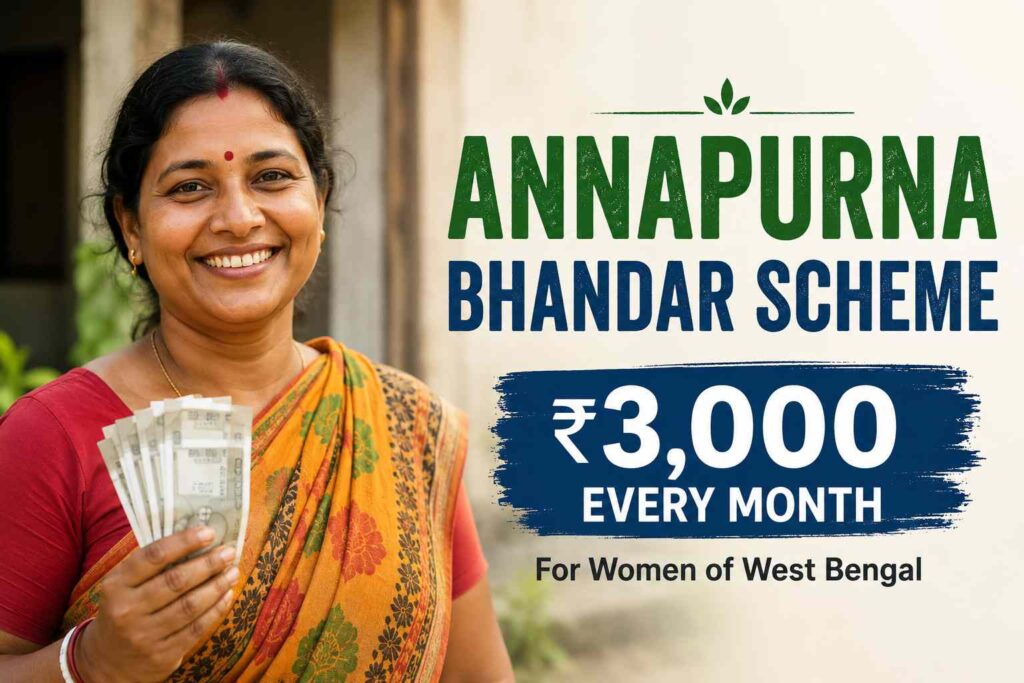
The Government of West Bengal has officially released the new guidelines and application process for the Annapurna Bhandar Scheme, also known as Annapurna Yojana. The scheme is set to replace the earlier Lakshmir Bhandar scheme and will provide ₹3,000 per month directly into the Aadhaar-linked bank accounts of eligible women through the Direct Benefit Transfer (DBT) system.
The government released the new enrollment forms, verification instructions, and eligibility guidelines on May 28, 2026. Applications have now started both online and offline across the state.
This guide explains the complete application procedure according to the latest official process.
Official Launch Date:
According to the notification issued by the West Bengal Government:
- Application forms became available from May 27, 2026.
- The scheme will officially start from June 1, 2026.
- The enrollment drive will continue for 90 days.
Scheme Benefits:
- ₹3,000 per month
- Money transferred directly through DBT
- Amount credited into the Aadhaar-linked bank account
Background of Welfare Schemes in West Bengal
West Bengal has a long tradition of social welfare programs targeted at vulnerable sections of society. Successive governments in the state have launched schemes aimed at improving living standards and reducing economic inequality.
Programs such as Kanyashree, Rupashree, Swasthya Sathi, Sabooj Sathi, and Lakshmir Bhandar became highly influential in shaping the welfare landscape of Bengal. Among these, Lakshmir Bhandar gained significant popularity by providing monthly financial assistance to women. Under that scheme, women from the general category received ₹1,500 per month, while SC and ST women received ₹1,700 monthly assistance.
The Annapurna Bhandar Scheme is being projected as a larger and more comprehensive welfare initiative. Reports indicate that the scheme may provide a uniform monthly assistance of ₹3,000 to eligible women irrespective of caste category.
The transition from Lakshmir Bhandar to Annapurna Bhandar reflects changing political priorities as well as the growing importance of direct cash transfer programs in Indian governance.
Announcement and Launch
According to various reports, the Annapurna Bhandar Scheme was announced following the formation of a new government in West Bengal in 2026. Public reports state that the scheme was discussed during the first cabinet meeting held after the assembly elections.
The proposed rollout date for the scheme has been mentioned as June 1, 2026. Government announcements suggest that the initiative aims to improve women’s financial independence and strengthen household economic security.
In addition to monthly financial support, reports also indicated complementary welfare measures such as free travel for women on state-run buses.
The announcement generated enormous public interest because of the proposed increase in financial assistance compared to previous schemes.
Objectives of the Annapurna Bhandar Scheme
The Annapurna Bhandar Scheme has several major objectives aimed at social and economic development.
1. Women’s Financial Empowerment
The primary objective is to strengthen the economic independence of women by providing direct monthly financial assistance. The scheme recognizes women as key contributors to household management and aims to support their financial decision-making capacity.
2. Household Economic Stability
Rising inflation and increasing household expenses have placed pressure on low-income families. The monthly assistance is expected to help families manage expenditures related to food, healthcare, education, and utilities.
3. Reduction of Poverty
Direct benefit transfer programs can help reduce extreme financial vulnerability among economically weaker households. The Annapurna Bhandar Scheme aims to provide a minimum level of financial security.
4. Improvement of Nutritional Security
The symbolic use of “Annapurna” reflects the government’s focus on ensuring better household nutrition and food access.
5. Strengthening Social Welfare Infrastructure
The scheme is also intended to expand the state’s welfare delivery system through digital governance and direct bank transfers.
Key Features of the Scheme
Monthly Financial Assistance
The most significant feature of the scheme is the proposed monthly payment of ₹3,000 to eligible women beneficiaries.
Direct Benefit Transfer (DBT)
The assistance amount is expected to be transferred directly into the beneficiaries’ bank accounts through the DBT system. This approach aims to reduce corruption and ensure transparency.
Women-Centric Welfare Model
The scheme focuses specifically on women residents of West Bengal, recognizing their role in family welfare and economic stability.
Potential Replacement of Lakshmir Bhandar
Public reports suggest that Annapurna Bhandar may replace or upgrade the existing Lakshmir Bhandar scheme.
Digital Governance
The scheme is expected to rely heavily on digital verification systems, Aadhaar linkage, and banking infrastructure.
Eligibility Criteria
While detailed official guidelines are still evolving, publicly available information indicates several likely eligibility conditions.
Residence
Applicants must be permanent residents of West Bengal.
Gender
The scheme is intended for women beneficiaries.
Age Group
Some reports suggest eligibility may apply to adult women within a specified age range, possibly similar to previous welfare schemes.
Income Conditions
The scheme may target economically weaker families and exclude high-income taxpayers or financially stable households.
Government Employment Restrictions
Women employed in permanent government jobs may not qualify for benefits.
Who Is NOT Eligible?
The government has clearly mentioned several disqualification categories.
A woman cannot apply if she is:
- A permanent government employee
- A retired government employee receiving a pension
- Receiving a regular salary from government institutions
- An income taxpayer
- Working in government-aided institutions
- Receiving a pension from the state or central government bodies
Important Verification Rules:
The new form released yesterday includes strict verification procedures.
The government will now verify:
- Family income
- Land ownership
- Educational details of children
- Aadhaar records
- Voter list information
- Duplicate entries
- Pension status
- Government job records
This detailed verification process was introduced to remove fake beneficiaries and duplicate records from earlier welfare databases.
Documents Required for Application
Applicants must keep the following documents ready before applying. Mandatory documents are…
Identity Proof
- Aadhaar Card
Residence Proof
- Voter ID
- Ration Card
- Domicile certificate (if required)
Banking Documents
- Aadhaar-linked bank account passbook photocopy
Photographs
- Passport-size photos
Additional Documents
- Mobile number linked with Aadhaar
- Income proof (if requested)
- Family details
- Educational details of children (if applicable)
New Application Form Asks For:
The newly released 11-page form is more detailed than the old Lakshmir Bhandar form.
The government now asks for:
- Full family information
- Number of family members
- Property details
- Agricultural land details
- Educational details of children
- Employment details of family members
- Pension information
- Existing welfare benefits
The purpose of this expanded form is stricter beneficiary verification.
How to Apply Online
The government has released the online application procedure.
Step 1: Visit the Official Portal
Go to the official West Bengal Social Security portal: https://socialsecurity.wb.gov.in/login
Step 2: Download or Register
Applicants can either:
- Download the Annapurna form
OR - Apply directly online
Forms are available in:
- Bengali
- English
- Hindi
Step 3: Mobile OTP Verification
Enter:
- Mobile number
- OTP received on phone
This step verifies the applicant’s identity.
Step 4: Fill in Personal Information
Applicants must enter:
- Full name
- Father/Husband’s name
- Date of birth
- Aadhaar number
- Voter ID number
- Address
- Caste category (if applicable)
Step 5: Fill Family Details
This is the most important new section.
Applicants must provide:
- Names of family members
- Occupation details
- Educational details
- Pension information
- Monthly family income
- Property ownership information
Step 6: Bank Account Information
Applicants must enter:
- Bank name
- Account number
- IFSC code
- Aadhaar-linked account details
Important:
Only Aadhaar-linked bank accounts will receive DBT payments.
Step 7: Upload Documents
Applicants must upload scanned copies of:
- Aadhaar card
- Voter card
- Passbook
- Photograph
- Other supporting documents
Step 8: Submit Application
After submission:
- A reference/application number will be generated
- Save or print the acknowledgment receipt
This number is required for status tracking.
How to Apply Offline
The government has also launched offline enrollment facilities.
Where to Get Forms
Forms are available at:
- Block Development Office (BDO)
- Panchayat office
- Municipality office
- Duare Sarkar camps
- Janakalyan Shibir camps
Step 1: Collect Form
Take the Annapurna Yojana application form from the nearest government office.
Step 2: Fill the Form Carefully
Applicants must write clearly using block letters.
Mistakes may cause rejection.
Step 3: Attach Documents
Attach photocopies of all required documents.
Step 4: Submit Form
Submit the completed form at:
- Panchayat office
- Municipality office
- BDO office
- Government camp
Step 5: Receive Acknowledgment Slip
After submission:
- Officials will provide a receipt/reference number
Keep this safe.
Financial Implications
The Annapurna Bhandar Scheme is expected to involve massive government expenditure.
If millions of women receive ₹3,000 every month, the total annual expenditure could reach tens of thousands of crores. Some reports estimate an annual financial outlay exceeding ₹70,000 crore.
This raises important questions regarding:
- Fiscal sustainability
- Budget allocation
- Revenue generation
- Long-term welfare financing
Supporters argue that social welfare spending boosts economic activity and improves living standards. Critics, however, warn about increasing fiscal pressure on the state government.
Social Impact
Economic Relief for Women
The scheme has the potential to provide significant economic relief to women managing household expenses.
Increased Financial Inclusion
Bank account-based transfers encourage financial inclusion and digital banking adoption.
Rural Development
Rural women may particularly benefit from regular income support due to limited employment opportunities.
Improved Household Decision-Making
Direct transfers to women can strengthen their role in household financial decisions.
Reduction in Economic Dependency
Women receiving independent income may experience greater confidence and autonomy.
Verification and Fraud Prevention
Government authorities have reportedly initiated verification drives to identify fake beneficiaries and duplicate records.
Reports suggest that nearly 30 lakh questionable entries were identified during welfare database verification exercises.
To prevent misuse, the scheme may involve:
- Aadhaar authentication
- Bank account verification
- Family-level data collection
- Local administrative scrutiny
However, such detailed verification has also generated privacy-related concerns among citizens.
Cyber Fraud and Scam Risks
Following public interest in the scheme, several fake websites and fraudulent online forms reportedly appeared online. Police authorities warned citizens against sharing sensitive personal information with unauthorized sources.
Scammers allegedly attempted to collect:
- Bank account details
- Aadhaar numbers
- OTPs
- Personal documents
Authorities clarified that official enrollment would occur only through verified government channels.
This situation highlights the growing challenge of cyber fraud in welfare administration.
Technology and Digital Governance
Technology will likely play a central role in implementing the Annapurna Bhandar Scheme.
Aadhaar Integration
Aadhaar linkage may help eliminate duplicate beneficiaries.
Online Portals
Digital portals can simplify registration and status tracking.
DBT Infrastructure
The DBT system ensures faster and more transparent payments.
Data Analytics
Authorities may use analytics tools to identify fraud patterns and monitor beneficiary records.
Mobile Connectivity
SMS alerts and mobile applications may improve communication with beneficiaries.
Comparison with Lakshmir Bhandar
| Feature | Lakshmir Bhandar | Annapurna Bhandar |
|---|---|---|
| Monthly Benefit | ₹1,500–₹1,700 | ₹3,000 |
| Target Group | Women | Women |
| Payment System | DBT | DBT |
| Caste-Based Difference | Yes | Proposed uniform payment |
| Verification | Existing system | Expanded verification |
| Financial Scale | Large | Much larger |
The proposed Annapurna Bhandar Scheme represents a substantial expansion in welfare expenditure and coverage.
Application Status Check Process
Applicants can track their status online.
Step 1
Visit the official portal: https://socialsecurity.wb.gov.in/login
Step 2
Click: “Track Application Status”
Step 3
Enter:
- Application number
- Mobile number
Step 4
View status
Possible status messages:
- Pending
- Under Verification
- Approved
- Rejected
Common Reasons for Rejection
Applications may be rejected for:
- Wrong Aadhaar number
- Bank mismatch
- Incomplete form
- Duplicate entry
- Government employment
- Pension holder status
- Fake documents
- Mobile mismatch
Tips for Successful Approval
To avoid rejection:
- Use an Aadhaar-linked bank account
- Ensure the mobile number is active
- Fill in the correct family details
- Avoid duplicate applications
- Keep photocopies of all documents
- Submit clear photographs
- Verify spelling carefully
Economic Debate Around Welfare Schemes
The Annapurna Bhandar Scheme reflects a broader national debate about welfare economics.
Arguments in Favor
Supporters argue that:
- Direct transfers reduce poverty
- Women’s empowerment improves social outcomes
- Increased spending stimulates local economies
- Welfare improves human development indicators
Arguments Against
Critics argue that:
- Excessive welfare spending strains budgets
- Dependency culture may increase
- Productive employment generation should receive higher priority
- Political competition may encourage unsustainable promises
Both perspectives continue to shape public discourse.
Impact on Rural Women
Rural women may emerge as the biggest beneficiaries of the scheme.
In many villages, women have limited independent income sources. Monthly financial assistance can help them purchase food, medicines, educational materials, and daily necessities.
The scheme may also reduce financial dependence on male family members and improve women’s participation in local economic activities.
Impact on Urban Households
Urban families facing inflation, rising rents, and high living costs may also benefit.
The additional monthly support could help households manage:
- Grocery expenses
- School fees
- Electricity bills
- Medical expenses
- Transportation costs
For women working in informal sectors, the scheme may provide important economic stability.
Administrative Challenges
Implementing a scheme of this scale involves several challenges.
Identifying Genuine Beneficiaries
Ensuring that only eligible individuals receive benefits is a major administrative task.
Database Management
Maintaining accurate beneficiary databases requires technological efficiency.
Financial Burden
Continuous monthly payments require strong fiscal planning.
Infrastructure Gaps
Rural banking access and digital literacy remain concerns in some areas.
Public Awareness
Citizens need clear information about application procedures and fraud prevention.
Future Prospects
The future of the Annapurna Bhandar Scheme depends on effective implementation, financial sustainability, and public trust.
If successfully executed, the scheme could become one of India’s largest women-focused welfare programs. It may also influence welfare policy discussions in other states.
Possible future developments include:
- Expansion of eligibility
- Integration with health and nutrition programs
- Mobile-based beneficiary services
- Additional social security benefits
The scheme could become a model for combining digital governance with social welfare delivery.
Conclusion
The Annapurna Bhandar Scheme represents a major welfare initiative proposed for women in West Bengal. By promising ₹3,000 monthly assistance through Direct Benefit Transfer, the scheme aims to strengthen women’s financial independence, improve household stability, and expand social security coverage.
FAQs:
Q. What is the Annapurna Bhandar Scheme?
A. The Annapurna Bhandar Scheme is a welfare program launched by the Government of West Bengal to provide monthly financial assistance of ₹3,000 to eligible women through Direct Benefit Transfer (DBT).
Q. How much money will beneficiaries receive?
A. Eligible women will receive:
₹3,000 per month
Directly into their Aadhaar-linked bank account
Q. When will the scheme start?
A. According to the latest government notification:
Applications started in May 2026
Payments are expected to begin from June 2026 after verification
Q. Who can apply for Annapurna Bhandar?
A. A woman can apply if she:
Is a permanent resident of West Bengal
Is between 25 and 60 years old
Belongs to an eligible family category
Has an Aadhaar-linked bank account
Q. Is Aadhaar mandatory?
A. Yes. Aadhaar is compulsory for:
Identity verification
DBT payment
Beneficiary authentication
Q. Is Aadhaar-bank linking mandatory?
A. Yes. Without Aadhaar-bank linking, the DBT payment will not be processed.
Q. Can existing Lakshmir Bhandar beneficiaries apply?
A. Yes. Existing beneficiaries may be automatically migrated, but re-verification is compulsory.
Q. Do existing beneficiaries need to submit a new form?
A. Yes, beneficiaries need to update information or complete re-verification depending on government instructions.
Q. What is the official website for the application?
A. Official portal: https://socialsecurity.wb.gov.in
Q. Can applications be submitted offline?
A. Yes. Applications can be submitted offline through:
BDO offices
Panchayat offices
Municipality offices
Duare Sarkar camps
Q. Are government employees eligible?
A. No. Permanent government employees are not eligible.
Q. What is the age limit for the application?
A. Applicants must generally be between:
25 years and 60 years
Q. What if my Aadhaar details do not match my bank account?
A. You must correct the mismatch before applying; payment may fail.
Q. How can I check Aadhaar-bank linking?
A. You can check through:
Your bank branch
NPCI status check
Aadhaar service centers